
green tea tasting
hosted an intimate tea tasting in a bedroom

I have been a tea lover for most of my life, but mostly as a casual drinker. Since my recent discovery of tea c(m)ocktails, I have realized there is a whole world of tea left to be explored, especially in the USA. The tea ecosystem is quite similar to the wine world. Just like wine, tea has tannins, its growth is determined by climate and region, and is produced in colored varieties. In order to understand tea more deeply, I organized a focused tea tasting where we could only try green teas.
I asked folks to bring teas and I also bought some of my own teas from Red Blossom Tea Company, Asha Tea House, and from a Japanese tea tasting. I organized the teas into “rounds”. In each round, I provided a set of teas, had people blind rate the teas, and then revealed to them what the teas were. I ordered the teas by minimal difference from the simplest tea to the “king” tea.
I researched how to rate teas and I came up with these categories:
Umami: savory, brothy taste sensation
Bitterness/Astringency: drying sensation
Floral: flower-like taste
Vegetal: Grassy tasting notes
Nutty: Self-explanatory
Roasted: Self-explanatory
Body: Thickness and weight in mouth
Overall: How much did you like the tea?
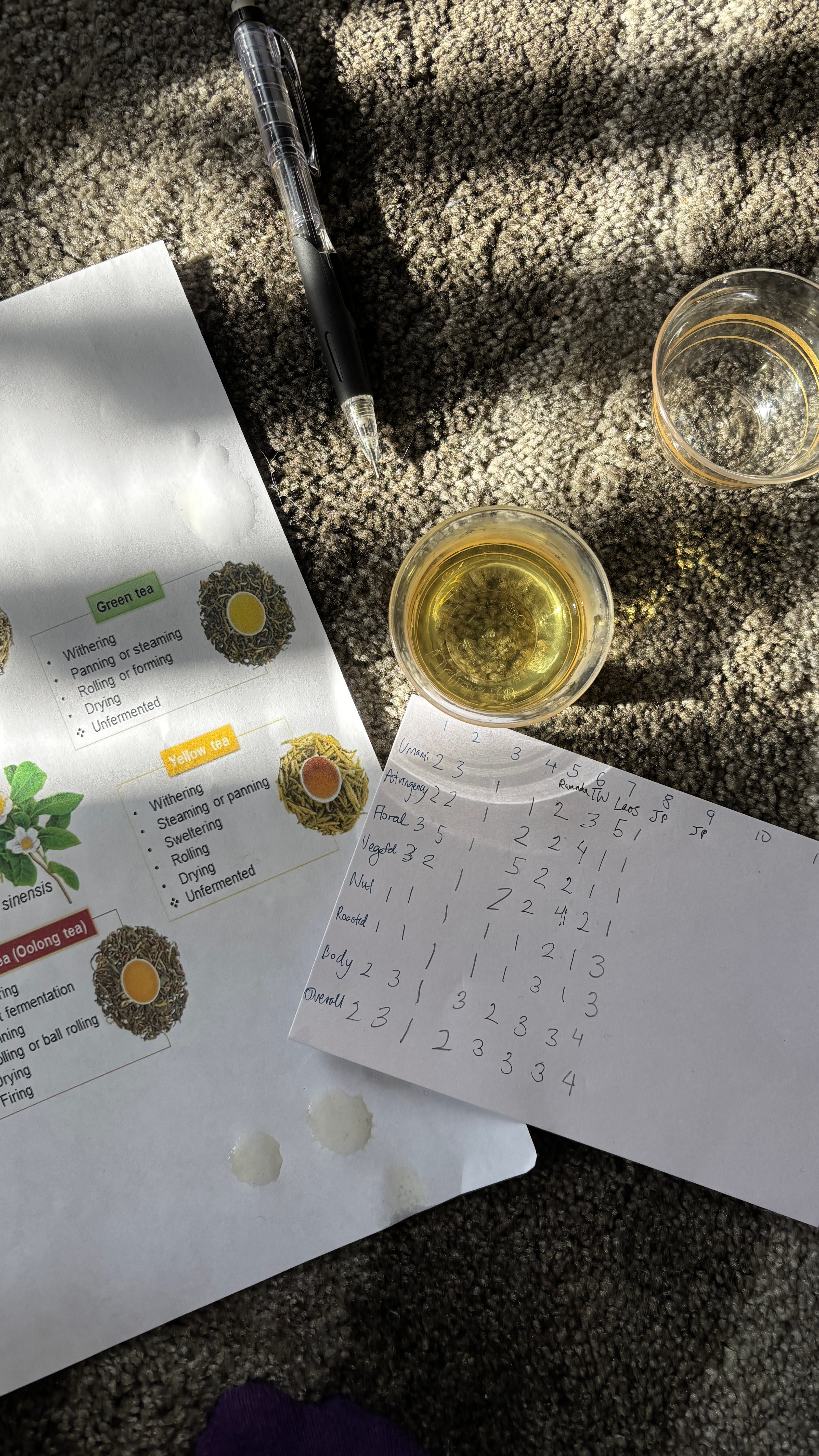
Round 1: Basic vs Fine Teas
I provided a Lipton Tea. This is a commercially available tea that most of us have tried. In the same round, I also provided a Cloud & Mist (Yun Wu). This is a grassy Chinese green tea.
People could tell that the second tea had a much fuller flavor than the Lipton. Across the board, the scores were higher for the Yun Wu.
Round 2: Compare Two of the Same
I provided two Spring Mao Feng teas from different sources.
Surprisingly, these two teas tasted very different, as if they were completely different teas. The former tasted more vegetal while the latter tasted more floral. I hypothesize that a third Spring Mao Feng to really isolate what about this flavor comes from the processing of being a Spring Mao Feng Tea.
Round 3: Tea Travels
Currently, most tea is grown in China, Japan, and Taiwan. These three countries have the most history processing and refining the art of tea. That being said, tea grows all over the world. In order to blind test the quality of tea elsewhere, I provided a Laoshan from Taiwan, a Thousand Hills from Rwanda, and a Paksong Stardust from Lao.
The Rwandan and Laotian teas had very distinct flavor profiles. Both tasted of more minerals than the Taiwanese tea. One friend guessed that the Rwandan tea was a Japanese tea and I was delighted to tell them it was not! The fan favorite of this batch was definitely the Pakson Stardust. It had a bright floral flavor and a strong aftertaste.
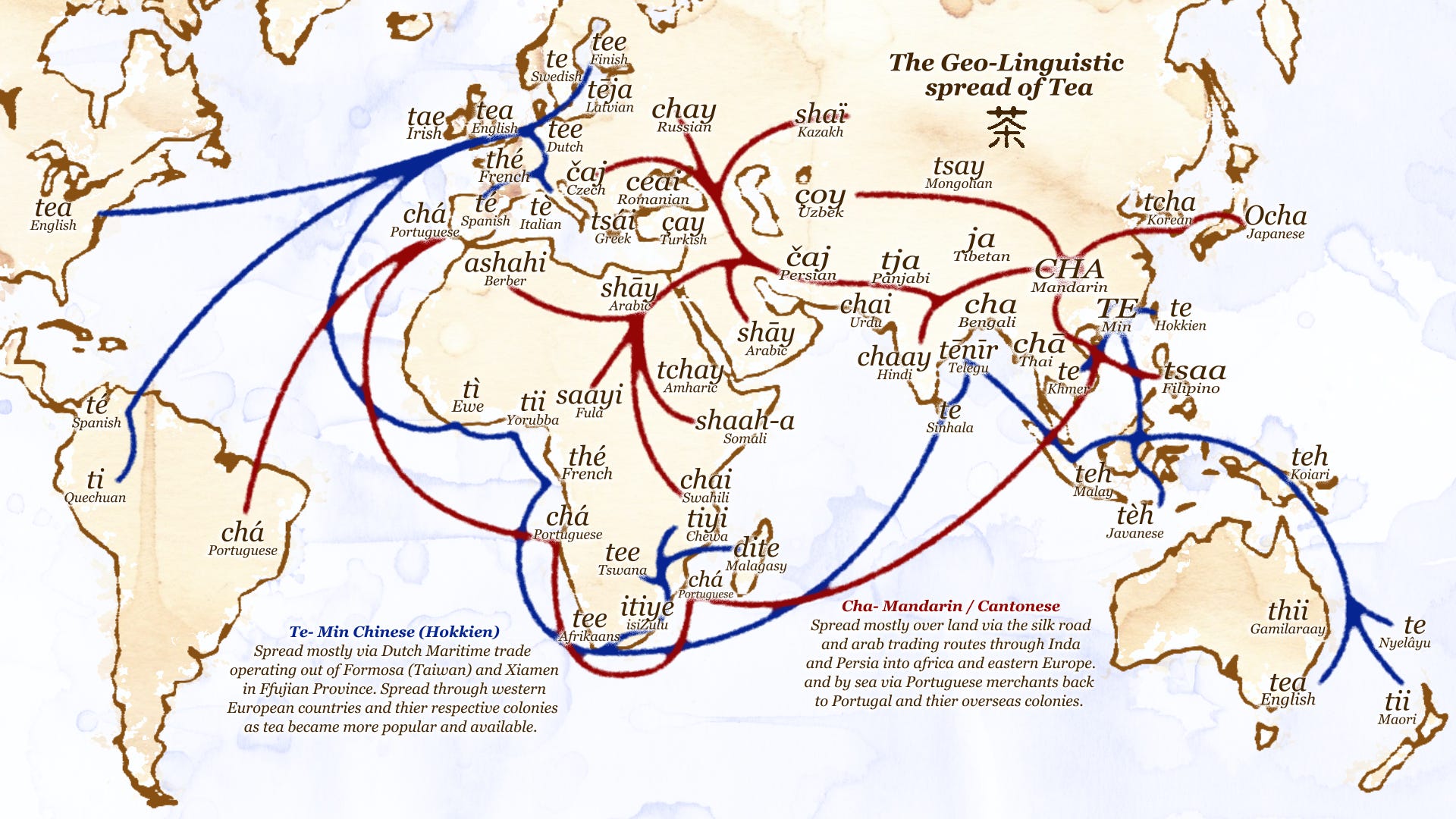
During this round, I shared a map of the global tea trade. While most of East Asia calls tea “cha”, the popularized “té” or “tea” came from Southern China. Meanwhile, “cha” was traded through the Persian route, where it became “shay” and made its way to India, where it was re-adapted as the popularized“chai”.
Round 4: Japanese Teas
I attended a Japanese tea tasting in Indonesia, from which I collected a rare green tea, Kamairicha. It is drank by 1% of Japanese tea drinkers and I have never seen it in stores in the US. Unlike most Japanese teas, Kamiaricha is pan fried instead of steamed. I also provided a Hojicha green tea, a deeply roasted green tea.
I was surprised to notice that most people slightly preferred the Hojicha to the rare Kamairicha. The ratings for both teas were very similar. This surprised me since the Hojicha tasted much more roasted than the Kamairicha. I didn’t have a tasting note for “fried”, but that probably was the missing piece to this rating.
Round 5: Dragonwell
For the final round, I provided a Dragonwell tea by itself. This is considered the King tea in China. It is pan fried and meant to provide a chestnut-y flavor. This was the only tea I did not pair with other teas, mostly because I did not have other teas on hand.
Takeaways
I think having a “round” with multiple options was a great way for people to really distinguish and compare flavors between teas. To me, the last round was the least memorable. I know I liked the Dragonwell, but it is hard to say what made it special. Comparison is the thief of joy, but also a great reference point.
People were really intrigued by the Tea Travels round. Given that there is a global matcha shortage, I think there could be a lot left to explored with tea worldwide. Especially since other regions have different terrains, there might be a whole world of tea flavors yet to be unlocked.
Once I load all the data, I will release the statistics of the tea ratings in a future post. I will have a website ready for rating teas at my next tasting and I’ll be looking into other ways to leverage technology for my favorite beverage.
Bonus: My friend and I are also starting a tea education TikTok, so stay tuned for many updates!