
tea on your brain
yes, you can get high on tea

Tea is any derivative of the Camellia Sinenis plant. Tea has several active ingredients including L-Theanine and Caffeine. Before we dive in, let us review our neuroscience background.
Neurons are nerve cells that send messages throughout your body. Presynaptic neurons are the neurons that contain vesicles packed with neurotransmitters, while Postsynaptic neurons are lined with receptor proteins. In simpler terms, presynaptic neurons transmit the neurotransmitters and postsynaptic neurons receive the neurotransmitters:
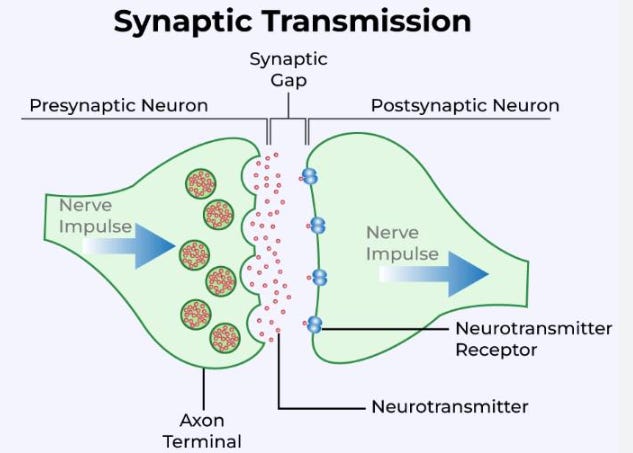
Neurotransmitters are chemicals that act as messengers between neurons. GABA is the primary inhibitory neurotransmitter. When it clings to a neuron, it prevents nerve cels from firing, which can promote a calming effect on the brain. As you guess, GABA is great for relaxing. Like GABA, Glycine is also an inhibitory transmitter but can act excitatory as well. Adenosine is another notable neurotransmitter. When adenosine binds to receptors, it causes drowsiness and the slowing down of cell activity.
When neurons pass neurotransmitters, they affect the frequency of brain waves. Here are a few categories of brain waves:
Alpha waves are associated with a relaxed, awake state. This state is often observed when people are daydreaming, meditating, or in flow.
Beta waves are associated with alertness and concentration. They are probably the most dominant when you’re actively thinking.
Delta waves are the slowest brain waves, associated with deep sleep.
What does l-Theanine do to the brain?
L-Theanine is an amino acid found primarily in tea leaves and mushrooms. L-Theanine structurally resembles the human body’s GABA and Glycine neurotransmitters. As a result, it targets the same neurons that stimulate the release of GABA and Glycine. When GABA and Glycine are released, these neurotransmitters cling to the neurons that release dopamine and serotonin.
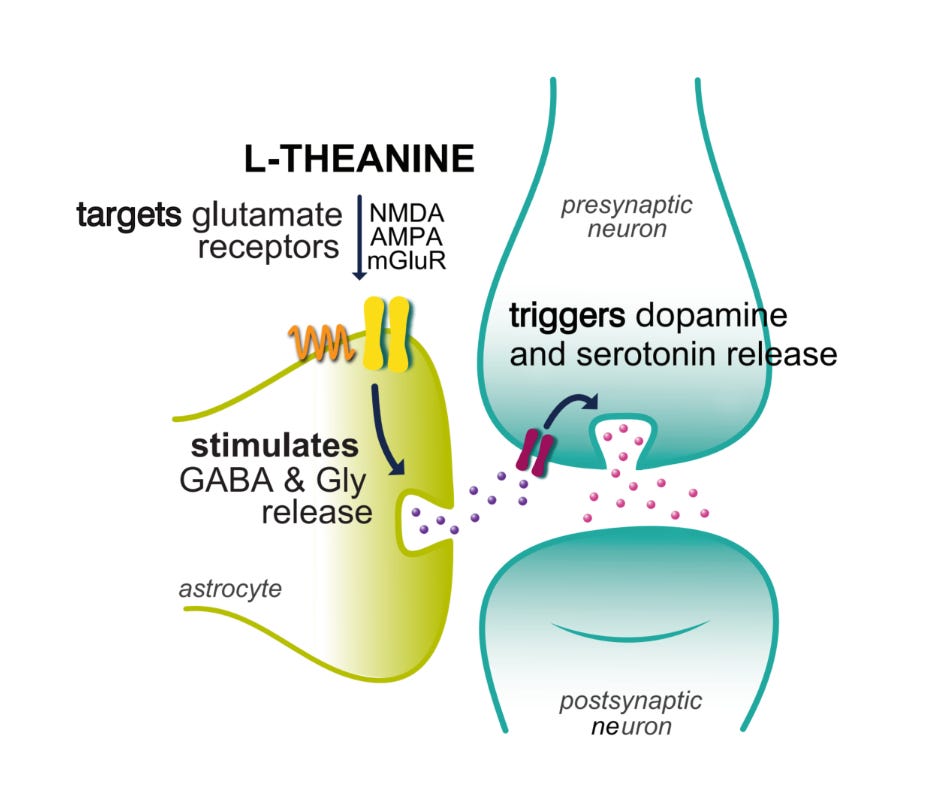
Tea’s L-Theanine crosses the blood brain barrier within 30 minutes. When people are dosed L-Theanine, they are usually prescribed 200 mg of L-Theanine to induce the alpha brain waves, or relaxed awake state. Tea contains about 25-60mg, so after two cups, you will be well on your way to a meditative state.
What does caffeine do to the brain?
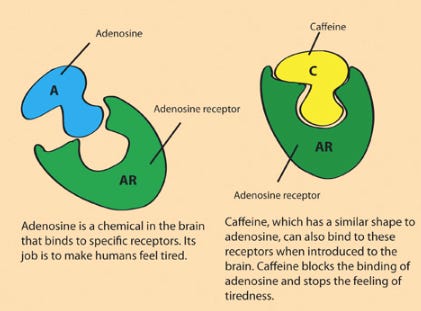
Caffeine is a drug that naturally occurs in tea and coffee. Caffeine looks structurally similar to Adenosine, the “drowsy” neurotransmitter. As a result, caffeine binds the adenosine receptors, taking up space that would otherwise go to adenosines. Instead of slowing down, Caffeine casues nerve cells to speed up and increase neuron firing. The pituitary gland senses this activity and signals for the body to produce adrenaline, the fight or flight hormone, which has a myriad of negative physiological effects on the body.
How does tea affect the brain?
The L-Theanine in tea diminishes the less desirable effects of caffeine. In fact, some studies have shown that L-Theanine is able to both blunt caffeine’s blood-pressure increasing an sleep disrupting effects, while not blunting the cognitive performance from caffeine.
So instead of getting the heart pressure from your morning coffee without losing the cognitive benefits, try switching to tea instead.